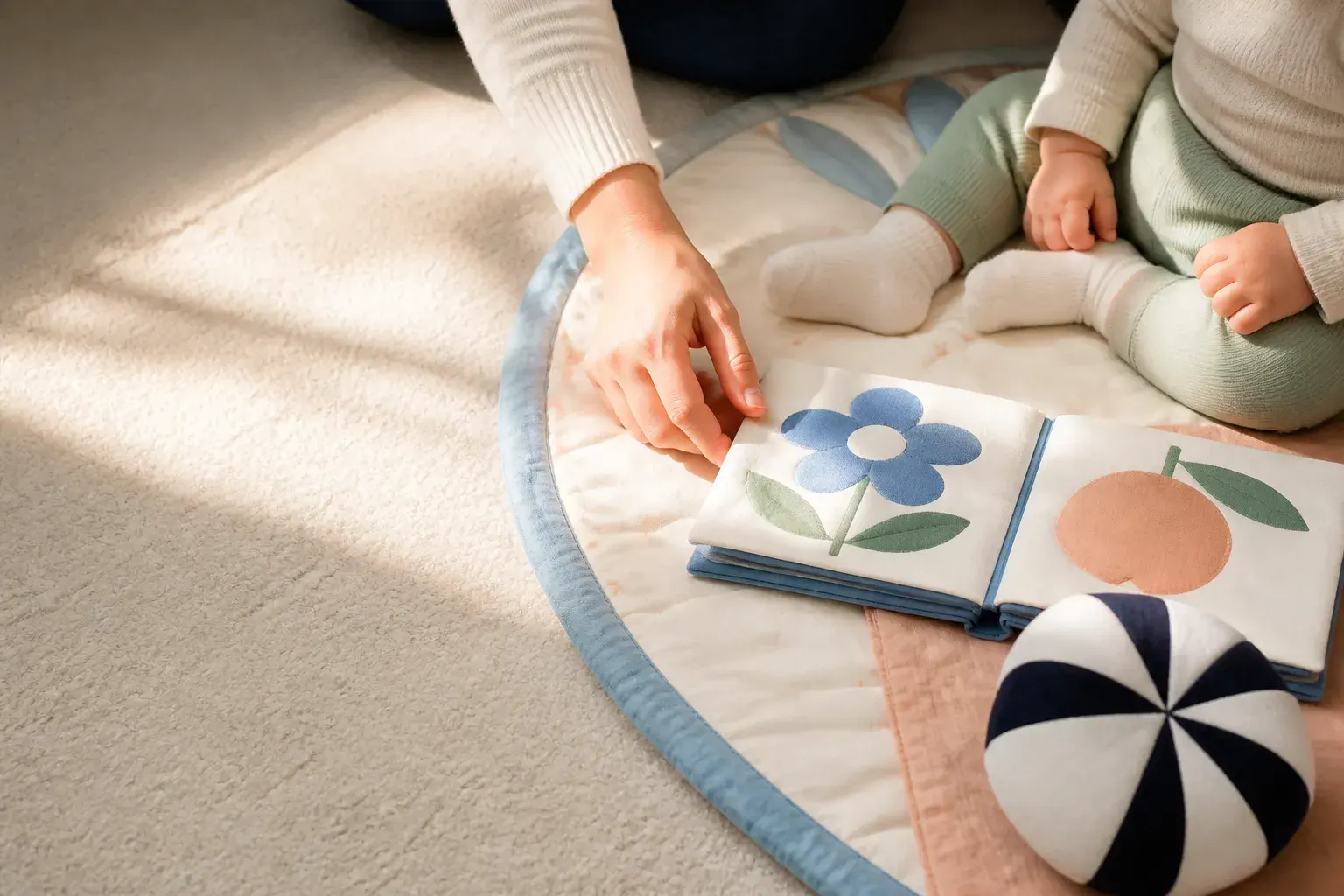
Connection is the activity
For a young baby, your voice, face, movement, and attention are already interesting. You do not need a craft project to make a meaningful moment.
Pick activities that fit the baby’s awake time and your energy. Stop when the baby looks tired, overstimulated, or ready for a feed.
The two-minute menu
Try narrating a diaper change, taking a slow room tour, singing the same song, looking at a high-contrast card, lying on the floor for face time, or taking a stroller walk when appropriate.
- Newborn: voice, face, contrast, gentle movement.
- Older infant: texture baskets, songs with pauses, peekaboo, and floor play.
- Mobile baby: simple containers, books, and supervised movement games.
Repeat is good
Babies often enjoy familiar rhythms more than novelty. Keep a few favorites in your pocket and make them yours. A dad’s repeated voice and predictable presence are part of the play.
Choose activities by cue and energy
A tired dad does not need a catalogue of impressive activities. Choose something that matches the baby’s awake time and your available attention: a song, a short book, a room tour, a few minutes of face-to-face time, or a gentle walk when appropriate.
Watch the baby rather than a timer. Turning away, becoming fussy, stiffening, yawning, or losing interest can be a cue to pause. The ability to stop is part of a good activity, especially for a young baby.
Repeat favorites without apologizing for repetition. A familiar voice and predictable rhythm can be more engaging than a new object. Narrating a diaper change or naming what you see turns ordinary care into connection.
Keep a tiny menu in your phone for low-energy days. The point is not to fill every awake minute. It is to make shared attention easy enough that it can happen even when the house is imperfect.
- Match the activity to the baby’s cue.
- Keep a two-minute version ready.
- Stop when the baby shows tired or overstimulated cues.
- Repeat familiar songs and books.
- Let care tasks count as connection.
Create an energy ladder
Make three versions of the same connection: one minute of talking while changing a diaper, five minutes of singing or looking at a book, and a longer walk or floor-play session when everyone has more energy. The ladder prevents a tired day from becoming a no-connection day.
Choose activities that keep the baby supervised and let the baby stop. Do not use stimulation to push through tired cues. A quieter voice, dimmer room, or pause may be the better activity.
Save the ideas that both of you enjoy. The point of a family activity list is not to perform variety; it is to make a few good moments easy to repeat.
- Make one-minute, five-minute, and longer versions.
- Stop for tired or overstimulated cues.
- Keep supervision and age fit in mind.
- Repeat activities that feel natural.
- Let quiet attention count as play.
Keep a no-equipment option
A voice, a face, a clean hand, and a few minutes are enough for connection. Keeping one activity that requires no object means tiredness or an unfinished nursery does not have to stop the interaction.
- Talk during ordinary care.
- Sing the same short song.
- Choose attention over equipment.
QUICK ANSWERS
Questions new dads ask
What activities can a dad do with a newborn?
Talk, sing, make eye contact, narrate care, hold the baby safely, read a short book, and take gentle walks when appropriate. Follow the baby’s cues and care guidance.
How long should baby play activities last?
Use the baby’s cues rather than a timer. A few calm minutes can be enough, especially for a newborn.
SOURCES
Read the primary guidance
Health and safety notes are summaries for general education. Follow your own care team’s advice.
Edited by the Dadwell editorial desk. We write for general education and link to primary guidance; when a question is personal, urgent, or medical, contact a qualified professional.